BE KIND TO SELF AND OTHERS – GET SUPPORT| GIVE SUPPORT
Defined by some of the client -Dyscalculia is –
‘Its like numbers are dancing in my head but does not make sense’,
‘it’s like things are slipping away from my hands I have no control over it’
‘Embarrassment and shame that I am not able to complete my task and how come it seems so easy when my siblings are working with their maths homework without struggle’
‘I hate numbers – I hate maths – I hate any books with numbers or maths’
People with Dyscalculia- most of us are not diagnosed but can experience and notice the tendencies. It can haunt even when we are adults as we can get triggered later in our lives about the past when we were in secondary school or college going through punishments when not completing maths homework or projects because numbers use to dance or cause confusion or did not make sense. We can feel the anxiety, shame, frustration in our body even after so many years. If we want to heal and work on managing dyscalculia- first, we can recognise that if there is struggle with numbers and how intense is it. Then we can access support Wajda Tabassum Counselling – Neuro Directory
We can offer to our ‘SELF’ Compassion, Kindness and Love as it’s not our fault that there is struggle with numbers.
Let’s explore what is Dyscalculia
Neurodiversity is natural and it embraces the idea that we all are different and have different ways of thinking, different ways of processing information different ways of problem solving.
It ranges from Neurotypical to Neurodivergent- Neurodivergent is a broad, community-driven term that celebrates cognitive diversity, reframing differences as variations rather than deficits, and highlighting the importance of understanding and accommodating diverse ways of thinking and experiencing the world.
The term Neurodivergent is used to describe usually people with Autism, ADHD, OCD, Dyspraxia, Dyslexia, Dyscalculia, and Tourette’s Syndrome.
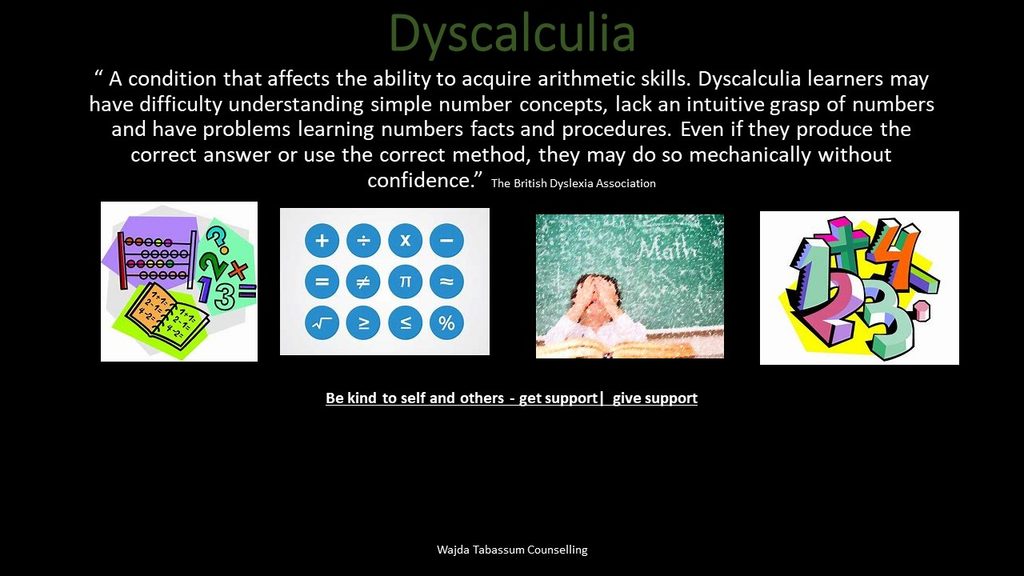
“Dyscalculia is a condition that affects the ability to acquire arithmetic skills. Dyscalculia learners may have difficulties understanding simple number concepts, lack an initiative grasp of numbers and have problems learning numbers facts and procedures. Even if they produce the correct answer or use the correct method, they may do so mechanically without confidence.” The British Dyscalculia Association
For some of us number does not make sense, Dyscalculia is a difficulty particularly in understanding and working with numbers. Maths anxiety commonly co-occurs with a SpLD (specific learning difficulty) in mathematics but is not an indicator of Dyscalculia itself.

Mathematics is a very varied discipline. Difficulties with learning mathematics may present in specific areas such as multiplications, subtraction, standard of teaching and instruction. As well as arithmetic, problem solving.
If we struggle with mathematics and if its persistence it can then have an impact on our life, work and our mental health. It can be debilitating experience for some of us with day-to-day struggle with study, homework, work project and day to day functioning.
Its important to recognise that person with Dyscalculia have their own strengths and heightened perception. Dyscalculia is a human experience and we cannot take it as a problem that need to be fixed. When we take Neurodiversity approach, we encourage inclusive approach to understand how human mind works and embrace different ways of doing things understanding things. This helps in overcoming the stigma and encourages the empathetic approach to thrive and survive. We all are okay as we are.
For emotional support and recognising struggle, processing and working on options to progress and live and learn fully if you need to book sessions please contact me by emailing:
E| wajdacounsellingandcoaching@gmail.com
T| 07506 166508